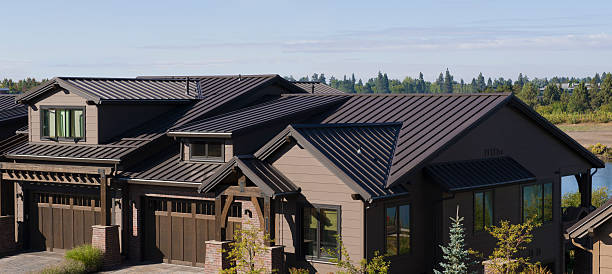
For many homeowners, the choice comes down to paying more upfront for a roof that's likely to last much longer versus paying less now and expecting to replace it sooner.
Here's a side-by-side comparison:
| Factor | Metal Roof (Standing Seam) | Architectural Asphalt Shingles |
|---|
| Typical lifespan | 40–70 years | 25–35 years |
| Upfront cost | About 2–3× the cost of architectural shingles (varies by region and roof complexity) | Lower upfront cost |
| Maintenance | Generally low; periodic inspections and occasional sealant or flashing maintenance | Low to moderate; individual shingles may need replacement over time |
| Wind resistance | Excellent when properly installed | Very good with high-quality shingles, but generally not as durable as standing seam metal |
| Snow & ice | Sheds snow well; can require snow guards over entrances or walkways | Snow tends to remain on the roof longer |
| Fire resistance | Excellent | Good, depending on the roofing assembly |
| Noise | Usually comparable to shingles when installed over solid decking with proper insulation | Quiet |
| Appearance | Modern or farmhouse styles; available in multiple colors | Traditional look that fits most neighborhoods |
| Repairability | Repairs can be more specialized | Individual damaged shingles are often easier and less expensive to replace |
Lifespan and long-term value
If you expect to stay in your home for decades, a metal roof may be the only roof you need to install during that time. With architectural shingles, there's a greater chance you'll replace the roof again later, depending on climate, installation quality, and maintenance.
Cost
The exact price depends on factors like roof size, pitch, complexity, and local labor rates, but as a rough example:
| Roof Size | Architectural Shingles | Standing Seam Metal |
|---|
| 2,000 sq ft roof area | ~$10,000–$20,000 | ~$20,000–$45,000+ |
These are broad estimates. Complex roofs with multiple dormers, valleys, skylights, or chimneys can cost substantially more.
Resale impact
A new roof of either type is generally a positive selling point because buyers know they likely won't face a replacement soon.
A metal roof may:
- Appeal to buyers looking for durability and lower long-term maintenance.
- Differentiate your home in some markets.
- Potentially increase buyer interest, though it doesn't necessarily add resale value equal to its full installation cost.
Architectural shingles:
- Meet buyer expectations in many neighborhoods.
- Improve curb appeal when replacing an old roof.
- Usually offer a stronger return on investment relative to their lower upfront cost, even if they don't last as long.
In most markets, buyers appreciate a newer roof more than the specific material, unless metal roofing is especially common or desirable in your area.
Which makes more sense?
Metal is often a good fit if:
- You plan to stay in the home 20+ years.
- You prefer lower long-term maintenance.
- You don't mind paying more upfront.
- You like the appearance of metal roofing.
Architectural shingles are often a good fit if:
- You want to minimize initial cost.
- You may move within the next 10–15 years.
- You prefer a traditional look.
- Most homes in your neighborhood have asphalt roofs.
For a home in New York, where roofs see snow, ice, and freeze-thaw cycles, both can perform well when installed correctly. The quality of the installation—including proper flashing, underlayment, ventilation, and ice-and-water protection—is just as important as the roofing material itself. A well-installed architectural shingle roof will generally outperform a poorly installed metal roof.